 Skip to content
A cardiac emergency can happen anywhere, at any time, and the difference between life and death often comes down to whether a working AED is nearby and whether someone knows how to use it. For small business owners and organizations looking to protect their employees, customers, and visitors, setting up a structured AED purchase program is one of the most impactful safety investments you can make.
But walking into this process without a plan can lead to costly mistakes: buying the wrong device, failing compliance requirements, or ending up with equipment that no one knows how to maintain.
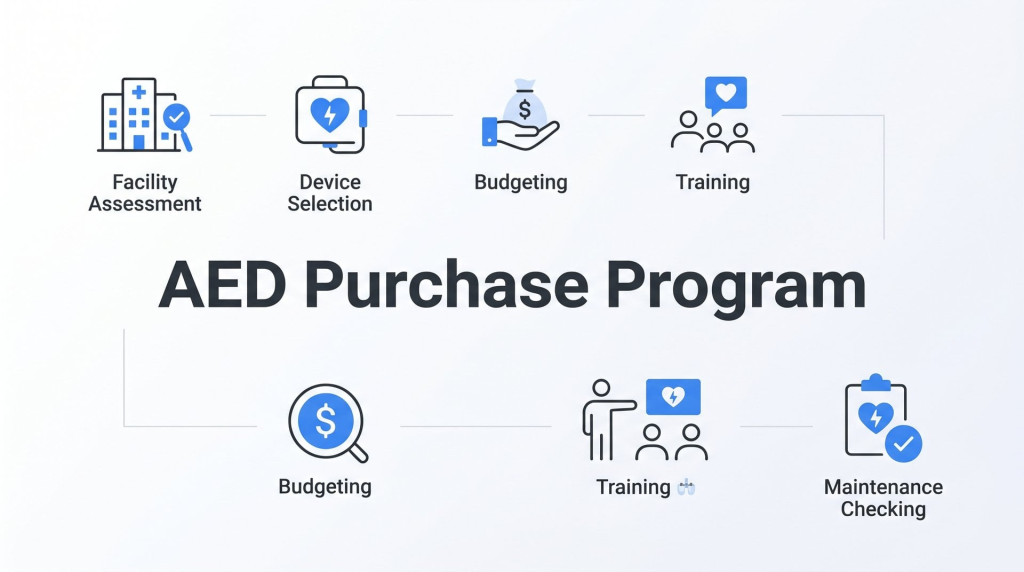
This guide walks you through every stage of building an AED purchase program from the ground up. You will learn how to assess your facility’s needs, choose the right AED models, budget properly, train your team, and keep your program running long after the initial purchase. Whether you are equipping a single office or multiple locations, these steps will help you make confident, informed decisions that actually protect people.
Step 1: Assess Your Facility and Legal Requirements
Before you spend a single dollar on equipment, you need a clear picture of your space and what the law requires of you. These two things will shape every decision that follows.
Start with a physical walkthrough of your facility. You are looking for high-traffic areas like lobbies, break rooms, and conference spaces, but also remote zones like warehouses, server rooms, or outdoor areas where someone could collapse and be out of sight. The key question to ask yourself in each location is this: if someone collapsed here right now, how long would it take to retrieve an AED and start using it? If the honest answer is more than three to five minutes, that area needs its own device or a nearby placement point.
Next, research the AED laws in your state and municipality. This step is non-negotiable. Many U.S. states have laws requiring AED placement in specific settings such as schools, fitness centers, and public buildings. Requirements vary significantly by state and sometimes by city or county. Some jurisdictions require you to register your AED with a local EMS agency. Others mandate specific signage, inspection schedules, or medical oversight. Good Samaritan protections, which shield trained responders from liability when using an AED in good faith, also vary by location.
If your business falls into a regulated category like childcare, healthcare, or recreation, check whether industry-specific rules apply on top of general state law. A fitness center, for example, may face stricter placement requirements than a standard office.
Document everything you find. Create a simple record that notes your facility layout, the number of floors and zones, and a summary of your legal obligations. This baseline document will guide your placement decisions in the next step and protect you if your program is ever audited. Understanding your AED certification requirements at the state level is an essential part of this documentation process.
Common pitfall to avoid: Skipping the legal research phase entirely and purchasing devices that do not meet local registration or inspection requirements. This can result in fines, liability exposure, and a program that is technically non-compliant even though the equipment is in place.
Step 2: Determine How Many AEDs You Need and Where to Place Them
Once you understand your facility and your legal obligations, you can start mapping out exactly how many devices you need and where they should go. This is where the three-to-five minute rule becomes your primary planning tool.
The principle is straightforward: from any point in your building, a bystander should be able to retrieve an AED and return to the victim within three to five minutes. That window accounts for the time needed to recognize the emergency, locate the device, retrieve it, and begin using it alongside CPR. In practice, this means you need to think about walking distance, not just square footage.
Factor in your building’s specific characteristics. Multi-story buildings typically require at least one AED per floor because taking an elevator or running stairs adds critical time. Larger open spaces like warehouses, gyms, or event halls may need more than one unit per level depending on the layout. Outdoor areas, parking lots, and loading docks are often overlooked but can be just as important, especially in facilities with high foot traffic or physical labor.
Occupancy levels also matter. A building with 200 employees working simultaneously has different needs than one where a small team rotates through shifts. Higher occupancy generally means higher risk, which supports placing devices in more locations. A strong emergency preparedness program for your business will account for all of these occupancy and layout variables when determining coverage.
When choosing exact placement spots, prioritize visibility and accessibility. AEDs should be easy to find in an emergency, ideally in locations people already know, like near fire extinguishers, at reception desks, or along main corridors. Avoid areas with temperature extremes, such as uninsulated storage rooms or spaces near heat sources, because temperature fluctuations can affect battery and pad performance.
Wall-mounted cabinets with audible alarms are a smart addition to any placement plan. The alarm sounds when the cabinet is opened, which deters casual tampering and also alerts nearby staff that an emergency may be in progress.
Practical tip: Draw a simple floor plan and mark each proposed AED location. Then walk the route from the farthest point in each zone to the nearest AED and time yourself. If you cannot make the round trip in under five minutes at a brisk walk, you need to reconsider the placement or add another unit.
Step 3: Choose the Right AED Models for Your Setting
Not all AEDs are built the same, and the right choice depends on your environment, your workforce, and how your program will be managed over time. This step is where many buyers make expensive mistakes by focusing only on the sticker price.
Start with the basics. Every AED you consider should offer clear voice prompts that guide a bystander through each step of the process. Most modern devices do this well, but the quality and clarity of those prompts can vary. Look for models that are genuinely intuitive for someone who has never used one before, because in a real emergency, that is exactly who may be reaching for it.
Consider these key features when comparing models:
Pediatric capability: If children are present in your facility, whether as employees, students, customers, or visitors, you need a device that can deliver a pediatric-appropriate shock. Some AEDs include a pediatric key or switch that adjusts the energy level automatically. Others require separate pediatric pads.
IP rating: The ingress protection rating tells you how well the device resists dust and moisture. If your AED will be placed in an outdoor cabinet, a warehouse, a gym, or any environment where it might be exposed to the elements, a higher IP rating is important for long-term reliability.
Fully automated vs. semi-automated: Fully automated AEDs deliver the shock without the user pressing a button, which can be helpful in chaotic situations or when untrained bystanders are responding. Semi-automated models require the user to press a shock button after the device advises it, which some trained responders prefer for the added control.
Battery and pad lifespan: This is where the real long-term cost lives. Some AEDs have electrode pads that expire in two years, while others last four or five. Batteries vary similarly. A cheaper device with short consumable lifespans can cost significantly more over a five-year period than a more expensive device with longer-lasting components.
Data connectivity: If you plan to use AED management software to track inspections and compliance, look for devices that support data download or wireless connectivity. This makes post-event review and program management much easier.
Models commonly used in workplace settings include the Philips HeartStart FRx, the Philips HeartStart OnSite, the Philips HeartStart FR3, the ZOLL AED Pro, the HeartSine Samaritan 350P, the Lifepak CR Plus, and Cardiac Science units. Each has strengths suited to different environments, and a knowledgeable vendor can help you match the right model to your specific setting. For a detailed comparison of top-rated options, reviewing the best AED devices to buy for your organization is a helpful next step.
Common pitfall to avoid: Choosing the cheapest unit without checking consumables costs or confirming that local service and support are available. An AED is only useful if it works when needed, and that requires ongoing maintenance with parts you can actually source.
Step 4: Build Your Budget and Explore Financing Options
A well-structured budget prevents surprises and helps you make a case to leadership or ownership for the investment. The key is breaking your costs into three clear categories rather than treating the device purchase as the only expense.
Category one: Device purchase. This is the upfront cost of the AED units themselves. Prices vary based on model, features, and whether you are buying through a corporate package. Corporate bundle pricing, offered by many major manufacturers and distributors, typically includes the device, electrode pads, a carry case, and sometimes a training AED at a reduced combined price. If you are purchasing multiple units, ask vendors directly about volume pricing. The savings can be meaningful.
Category two: Accessories and installation. Wall-mounted cabinets, signage, mounting hardware, and any electrical work for alarmed cabinets all add to your initial cost. These are easy to underestimate, especially in multi-location programs.
Category three: Ongoing maintenance. This includes replacement electrode pads, battery replacements, and any inspection or management services. Some AED management service providers offer subscription models that spread these costs out and include automated reminders, compliance documentation, and consumable replacements on a scheduled basis. For organizations that want to minimize administrative burden, this kind of service can be worth the investment. Reviewing the AED service contract options available to businesses can help you understand what is typically covered and what to look for.
Do not forget to budget for CPR and AED training. Training is a required or strongly recommended component of any responsible AED program, and it is a recurring cost because certifications need to be renewed, typically every two years, and new staff need to be trained as they join.
On the funding side, grant programs are worth exploring before you finalize your budget. Some state health departments, the American Heart Association, and other nonprofit organizations offer funding for AED placements in qualifying organizations. Availability and eligibility requirements change over time, so check directly with your state health department and relevant foundations to see what is currently available in your area.
Practical tip: Build your budget as a five-year total cost of ownership, not just a year-one purchase cost. This gives you a much more accurate picture of what the program actually costs and makes it easier to compare device options fairly.
Step 5: Register Your AEDs and Complete the Purchase
With your plan finalized and your budget approved, it is time to make the purchase and complete the administrative steps that turn a box of equipment into a compliant, functional safety program.
Start with registration. Many jurisdictions require AED owners to register their devices with a state or local EMS agency. This is not just a legal formality. In many areas, registered AEDs are added to a database that 911 dispatchers can access, which means that when someone calls from your building, the dispatcher can direct the caller to the nearest AED by name and location. That kind of real-time guidance can shave critical seconds off response time.
Even if registration is not legally required in your jurisdiction, check whether your area has a voluntary AED registry program. Registering voluntarily costs nothing and can make a real difference in an emergency.
When completing your purchase, keep your documentation organized from day one. Create a dedicated safety file, physical or digital, that includes purchase receipts, serial numbers, warranty information, and registration confirmations for each device. This file will be essential for maintenance tracking, warranty claims, and any compliance audits. A fully structured workplace AED program framework can help ensure none of these administrative steps are overlooked.
Confirm with your vendor that post-sale support is included or available. This means firmware updates when manufacturers release them, recall notifications if a device or consumable is affected, and clear guidance on who to contact if a device malfunctions. A reputable vendor should be able to answer all of these questions before you finalize the sale.
Once devices arrive, install them in their designated locations immediately. Do not let them sit in boxes. Verify that every cabinet is securely mounted, every status indicator light is green, and every device is ready for use. Walk each installation location one more time to confirm the placement makes sense in the real space.
Final check: Notify your local 911 dispatch center of your AED locations if your jurisdiction supports an AED registry program. This small step costs nothing and ensures your investment is fully integrated into the emergency response system in your area.
Step 6: Train Your Team and Assign Responsibilities
An AED sitting on a wall is only as useful as the people around it. This is the step that most directly determines whether your program saves a life when it matters, and it is also the step that organizations most commonly underinvest in.
Schedule CPR and AED certification training for all designated responders before or immediately after device installation. Ideally, training happens before the devices go up so that your team is ready from day one. At a minimum, every person who might realistically be first on scene in an emergency should be certified. That often means front desk staff, security personnel, facility managers, and team leads across departments.
The training itself should be hands-on. Reading a manual or watching a video is not the same as practicing chest compressions on a manikin and walking through AED operation in real time. In-person and blended training formats are available for teams of all sizes, and group corporate training can be scheduled at your location for convenience. This eliminates the logistical challenge of sending employees off-site and allows the trainer to familiarize your team with the specific AED models installed in your building.
Assign a program coordinator as part of this step. This person is responsible for tracking certification expiration dates, scheduling renewal training, performing or delegating monthly device inspections, and managing consumable replacements. Without a named owner, these tasks tend to fall through the cracks.
Post clear signage throughout your facility directing people to AED locations. In an emergency, no one should have to guess or ask. Signage should be visible from main walkways and consistent throughout the building.
Conduct at least one practice drill after training is complete. Walk your team through a simulated scenario: someone collapses in the lobby, who calls 911, who retrieves the AED, who starts CPR, and how do they hand off responsibilities when the device arrives. This kind of rehearsal removes hesitation from a real event. Understanding how to earn and maintain your AED training certification ensures your team stays current between drills.
Common pitfall to avoid: Installing AEDs without training staff. This is surprisingly common and leaves the equipment effectively unused in a real emergency because bystanders are unsure or afraid to act. Training is what converts a piece of equipment into a functional lifesaving tool.
Step 7: Set Up an Ongoing Maintenance and Inspection Schedule
Your AED purchase program is not finished once the devices are on the wall and the team is trained. The ongoing maintenance phase is what keeps your program compliant and your equipment ready to perform when it is actually needed.
Monthly visual inspections are the foundation of any maintenance routine. Each inspection should confirm that the device is present in its designated location, that the status indicator light is showing green or the equivalent ready signal for your specific model, and that no alerts or warning lights are active. Check that the cabinet is undamaged and that the electrode pads and battery are visible and appear intact. This inspection takes less than two minutes per device and catches most problems before they become emergencies.
Track expiration dates for electrode pads and batteries carefully. Pads typically expire within two to five years depending on the manufacturer, and batteries have their own separate expiration timelines. Replace consumables before they expire, not after. A device with expired pads may still power on and appear functional, but its ability to deliver an effective shock is compromised.
Document every inspection in a maintenance log. Record the date, the inspector’s name, the device serial number, and the outcome of the inspection. If any issue is found, note what action was taken and when. This log is your evidence of due diligence if your program is ever reviewed.
Consider enrolling in an AED management program that automates inspection reminders and provides compliance reporting. Respond and Rescue offers AED management services designed to take the administrative burden off your team while keeping your program fully documented and current. Instead of relying on someone to remember when pads expire, the system tracks it for you.
Review your entire program at least once per year. Facility layouts change, staff turns over, and regulations get updated. An annual review ensures your placement plan still makes sense, your coordinator is current, and your program reflects any new legal requirements.
Important note: After any real-world use of an AED, the device must be serviced and restocked before being returned to service. Used electrode pads must be replaced, the device should be inspected for any damage, and a post-event review should be documented. Never assume a device is ready to use again without going through this process.
Putting It All Together: Your AED Program Checklist
Setting up an AED purchase program is not a one-time task. It is a commitment to keeping your workplace prepared for cardiac emergencies year after year. By following these seven steps, you move from uncertainty to a structured, compliant, and well-maintained program that gives everyone in your building a real chance of survival if the worst happens.
Use this checklist to confirm you have covered every stage:
Facility assessment complete: You have walked the space, identified high-risk zones, and documented your legal obligations.
Placement locations identified: Every area of your facility is within a three-to-five minute retrieval window, and cabinet placements are confirmed.
AED models selected: You have matched device features to your environment and calculated the true five-year cost of ownership.
Budget finalized: Device costs, accessories, training, and ongoing maintenance are all accounted for, and any grant opportunities have been explored.
Devices registered and installed: All units are mounted, status indicators are green, and registrations with local EMS or 911 dispatch are complete.
Team trained and certified: Designated responders hold current CPR and AED certifications, a program coordinator is assigned, and a practice drill has been completed.
Maintenance schedule in place: Monthly inspections are assigned, expiration dates are tracked, and a maintenance log is active.
If you want support at any stage of this process, Respond and Rescue offers AED sales, corporate training, and AED management services designed to make the entire process straightforward. From choosing the right device to keeping your team certified, we are here to help you build a program that actually works when it matters most.
When a real emergency hits, there is no pause button and no second chances. Get hands-on CPR, First Aid, and AED training that prepares you to act fast and with confidence when it matters most. Find a local class or schedule your on-site training now and leave certified, prepared, and ready to save a life.


