 Skip to content
You need CPR certification — fast. Your employer requires it, your state license is up for renewal, or you’re a parent who’s been putting this off for months. Either way, you’re staring at training schedules filled with six-hour Saturday sessions that conflict with your kid’s soccer game, or weekday classes that mean taking a full day off work.
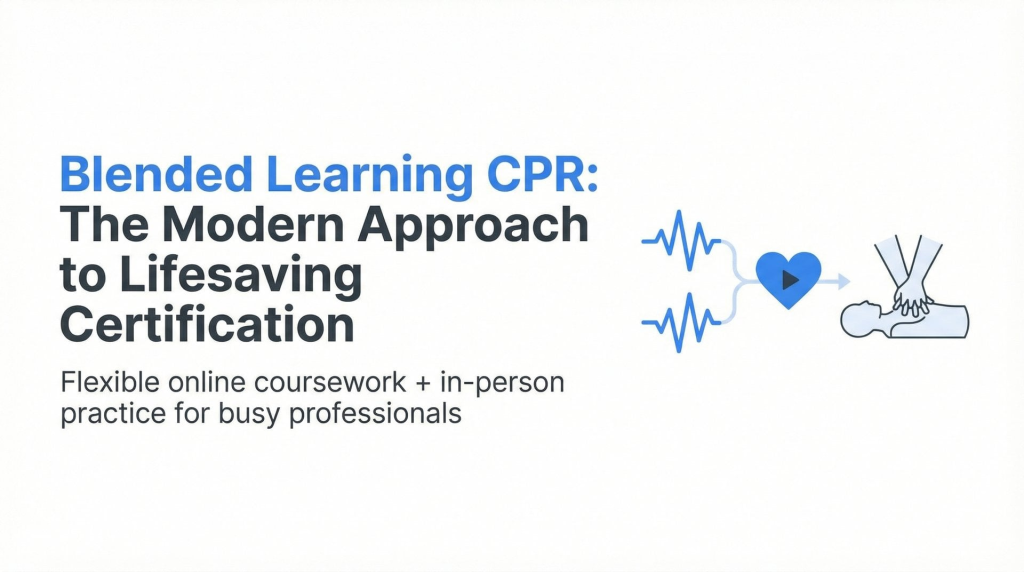
In 2026, there’s a smarter way. Blended learning CPR — combining online coursework with a focused hands-on skills session — has become the go-to format for busy professionals, healthcare providers, and small business teams across the country. This modern approach splits your certification into two parts: online modules you complete at your own pace, followed by a streamlined in-person session where you practice real techniques on manikins under the eye of a certified instructor.
This isn’t about shortcuts or watered-down training. Blended learning CPR delivers the exact same certification as traditional all-day classroom courses, recognized by the American Heart Association, American Red Cross, employers, and regulatory bodies nationwide. The difference? You learn the cognitive content on your schedule — then show up for a focused skills session that proves you can perform CPR when someone’s life depends on it.
In this guide, we’ll walk through exactly how blended learning CPR works, who benefits most from this format, and what to look for in a quality program. Whether you’re a small business owner trying to certify your team without shutting down for a day, or an individual who learns better at your own pace, you’ll discover why this training approach has become the top choice for people who need real skills without the scheduling nightmare.
The Two-Part Structure That Makes Blended Learning Work
Blended learning CPR isn’t a single event. It’s a carefully designed sequence that separates what you need to know from what you need to do, then brings them together when it matters.
The first part happens entirely online, on your schedule. You’ll log into a learning platform and work through modules covering the cognitive foundation of CPR: recognizing cardiac arrest, understanding the chain of survival, knowing the steps of high-quality CPR, and learning when and how to use an AED. Think of this as the “why” and “what” of lifesaving. You’re watching videos of proper technique, reading through emergency scenarios, and taking knowledge checks that ensure you understand the concepts before you ever touch a manikin.
This online portion typically takes two to three hours, depending on the certification level and how quickly you move through the material. You can pause whenever you need to, come back later, and pick up exactly where you left off. Some people knock it out in one evening. Others spread it across a few lunch breaks. The platform tracks your progress and won’t let you skip ahead until you’ve demonstrated understanding of each section.
Here’s what separates legitimate blended learning from questionable online-only courses: the mandatory in-person skills session. After completing your online coursework, you’ll receive a certificate of completion that’s valid for a limited time, usually 60 to 90 days. This certificate gets you into the BLS blended learning skills session, but it’s not your CPR certification. Not yet.
The skills session is where theory becomes muscle memory. You’ll show up at a training center with your completion certificate, and an instructor will guide you through hands-on practice on manikins. This isn’t a lecture. You’re on the floor, performing compressions, positioning your hands correctly, achieving proper depth and rate, practicing rescue breaths, and operating an AED trainer. The instructor watches your technique, provides immediate feedback, and corrects issues in real time.
Most skills sessions run one to two hours and include practice scenarios where you respond to simulated emergencies. You’ll demonstrate adult CPR, often child and infant CPR depending on your certification level, choking relief techniques, and AED operation. Only after you successfully demonstrate competency on each required skill does the instructor issue your official CPR certification card, valid for two years just like traditional classroom certifications.
This structure works because it puts your learning time where it’s most efficient. The knowledge portion happens when and where it’s convenient for you. The hands-on practice happens in a focused session where every minute is spent building the physical skills that actually save lives, not sitting through lectures you could have watched at home.
Who Gets the Most Value from This Training Format
Blended learning CPR wasn’t designed for everyone, but for certain people and situations, it’s the difference between getting certified and putting it off indefinitely.
Small business owners and managers: You’re juggling staff schedules, customer demands, and a hundred competing priorities. Taking an entire day to sit in a CPR class means closing early, paying overtime for coverage, or simply not being available when your business needs you. Blended learning lets you complete the online portion during slow periods or after hours, then bring yourself or your team in for a two-hour skills session that doesn’t disrupt operations for an entire day. When you need to certify multiple employees, you can have everyone complete the online work independently, then schedule a single group skills session that gets everyone certified in one efficient block.
Healthcare professionals seeking recertification: If you’re a nurse, EMT, or other medical professional, you already know CPR. You’ve performed it, you understand the theory, and you just need to maintain your certification. Sitting through six hours of content you could teach yourself feels like wasted time. Blended learning respects your existing knowledge. You move through the online review at whatever pace makes sense, skip the redundant lectures, and show up for the skills check to prove your technique is still sharp. The BLS CPR AED for healthcare providers course is particularly well-suited to this format.
Parents and caregivers with unpredictable schedules: You want to know CPR for your kids, your aging parents, or the children you care for. But between school pickups, doctor appointments, and the general chaos of caregiving, committing to a full-day Saturday course feels impossible. What happens when your child gets sick the morning of the class? You’ve paid, you can’t attend, and you’re back to square one. Blended learning gives you flexibility. Complete the online work during naptime, after bedtime, or whenever you can carve out focused time. Then schedule your skills session for a time when you have reliable childcare or your partner can cover.
Self-paced learners who absorb information better on their own: Not everyone thrives in a classroom setting. Some people learn better when they can pause, rewind, and review content at their own speed without feeling rushed or holding up a group. If you’re someone who likes to take notes, look up additional information, or simply think through concepts before moving forward, the online portion of blended learning lets you learn the way that works for your brain. Then you show up to the skills session ready to practice, not still trying to absorb the foundational knowledge.
The common thread? People who value their time, need scheduling flexibility, and want certification that’s efficient without being superficial. Blended learning CPR works when you need the credential and the competence, but you need it to fit your life instead of forcing your life to fit a rigid training schedule.
How Blended Learning Compares to Traditional Classroom Training
Let’s address the question directly: is blended learning CPR as good as traditional classroom training? The short answer is yes, when it’s done right. The certifications are identical, the skills are identical, and the recognition is identical. What’s different is how you get there.
Traditional classroom CPR courses typically run four to six hours in a single session. You arrive at a training center, sit through lectures covering cardiac arrest recognition, CPR steps, AED use, and choking relief. Then you transition to hands-on practice for the second half of the class. Everyone moves through the material at the same pace, regardless of whether you already understand the concepts or need extra time to absorb them. The advantage? Everything happens in one day. You walk in uncertified, you walk out certified. The disadvantage? That one day needs to fit your schedule, and you’re paying for instructor time even during the lecture portions you could have learned independently.
Blended learning splits that same content into two distinct phases. The online portion covers all the cognitive material, the lectures, the knowledge checks, and the theoretical understanding. This typically takes two to three hours that you complete on your own schedule over days or weeks. The in-person skills session focuses exclusively on hands-on practice, usually running one to two hours. Total time investment is similar to traditional courses, sometimes slightly less because there’s no transition time between lecture and practice, no waiting for slower learners to catch up during knowledge portions, and no redundant content for people who already understand the basics.
From a learning retention perspective, both formats work when delivered properly. Traditional courses benefit from immediate application: you learn a concept and practice it moments later. Blended learning benefits from spaced repetition: you learn concepts online, they settle in your mind for days or weeks, then you reinforce them through physical practice at the skills session. Some research suggests that spacing out learning actually improves long-term retention compared to cramming everything into one session. Your brain has time to process and consolidate the information before you layer on the physical skills.
Certification validity is identical. A CPR certification earned through blended learning from the American Heart Association is the same two-year certification you’d receive from their traditional classroom course. Employers don’t distinguish between the two. OSHA doesn’t distinguish between the two. State licensing boards don’t distinguish between the two. The card in your wallet looks the same, expires on the same timeline, and carries the same recognition. What matters is that the program is accredited by a recognized certifying body and includes the mandatory hands-on skills component.
The real difference comes down to learning preference and logistics. If you learn best in structured group settings, prefer immediate instructor access for questions, and can block out a full day, traditional classroom courses work perfectly. If you value flexibility, learn effectively from video instruction, and need to work certification around other commitments, blended learning delivers the same outcome with better schedule compatibility. Neither is superior. They’re different paths to the same destination: competent, certified, and ready to respond in an emergency.
The Hands-On Skills You’ll Master During Your In-Person Session
The skills session is where blended learning proves it’s not a shortcut. This is the component that separates legitimate certification from dubious online-only courses that hand out certificates without ever verifying you can actually perform CPR.
You’ll start with adult CPR on a manikin designed to provide realistic feedback. The instructor demonstrates proper hand placement on the center of the chest, correct body positioning with shoulders directly over the manikin, and the compression technique that achieves adequate depth and rate. Then it’s your turn. You’ll perform continuous chest compressions while the instructor watches your form, corrects your hand position if needed, and ensures you’re compressing deep enough. Many training manikins include feedback mechanisms that click or light up when you achieve proper depth, giving you immediate confirmation that your technique would be effective on a real person.
Compression rate matters as much as depth. You’re aiming for 100 to 120 compressions per minute, which feels faster than most people expect. The instructor will help you find and maintain that rhythm, often using the beat of a familiar song as a reference. You’ll practice until the rate becomes automatic, until your arms know the pace without conscious counting.
Next comes rescue breathing technique. You’ll learn proper head tilt and chin lift to open the airway, how to create an effective seal with the rescue mask or barrier device, and how to deliver breaths that make the chest visibly rise without overinflating the lungs. The instructor watches to ensure you’re not hyperventilating the manikin or delivering breaths that are too shallow to be effective. You’ll practice the full CPR cycle: 30 compressions followed by 2 rescue breaths, then immediately back to compressions without significant pauses.
AED operation is next on the skills checklist. You’ll work with an AED trainer that simulates the real device without delivering actual shocks. The instructor will set up a scenario: you’ve performed CPR, someone brings an AED, now what? You’ll practice powering on the device, following the voice prompts, placing the electrode pads correctly on the manikin’s bare chest, ensuring everyone is clear before the shock, and resuming CPR immediately after the AED delivers its shock or advises no shock is needed. This is where many people realize how user-friendly modern AEDs actually are. The device talks you through every step, but practicing with an instructor present builds the confidence to use it under pressure. The ZOLL AED with Real CPR Help is an example of technology designed to guide rescuers through the process.
If your certification includes child and infant CPR, you’ll repeat the process on smaller manikins with modified techniques. Child CPR uses one or two hands depending on the child’s size, with slightly less compression depth than adult CPR. Infant CPR requires two-finger compressions on a baby manikin, demonstrating the gentle but effective technique needed for the smallest patients. The instructor ensures you understand when to use each technique and can adapt your approach based on the victim’s size.
Choking relief rounds out the skills session. You’ll practice abdominal thrusts on an adult manikin or training vest, learning proper hand placement and the inward-and-upward motion that dislodges airway obstructions. For infants, you’ll demonstrate the combination of back blows and chest thrusts used when a baby is choking. These are skills you hope to never use, but practicing them on manikins ensures you won’t freeze if you ever face a real choking emergency.
The entire skills session is performance-based. The instructor doesn’t just watch you practice. They’re evaluating whether you can perform each skill to the standard required for certification. If your compression depth is insufficient, you’ll practice until you get it right. If your AED pad placement is incorrect, you’ll do it again. This isn’t about passing or failing in a punitive sense. It’s about ensuring that when you walk out with a certification card, you actually possess the skills that card represents.
Selecting a Program That Delivers Real Competence
Not all blended learning CPR programs are created equal. The format itself is sound, but execution varies wildly. Here’s how to identify programs that prioritize actual competence over just handing out cards.
Certification body recognition comes first: Your program should be affiliated with a nationally recognized certifying organization. The American Heart Association and American Red Cross are the gold standards, but other legitimate organizations include the American Safety and Health Institute (ASHI) and the National Safety Council. These organizations maintain quality standards, provide standardized curricula, and issue certifications that employers and regulatory bodies recognize. If a program is offering “CPR certification” without clear affiliation with a recognized certifying body, that’s your first red flag.
Ask specific questions about the skills session: How long does it last? What’s the student-to-instructor ratio? How many manikins will be available for practice? A quality skills session should provide at least one to two hours of hands-on time with adequate instructor attention for each student. If a program advertises a 30-minute skills check or packs 20 students into a session with one instructor and three manikins, you’re not getting sufficient practice time or feedback. Good programs limit class sizes to ensure everyone gets meaningful hands-on time and individualized instruction.
Instructor qualifications matter: Your skills session instructor should be a certified CPR instructor through the same organization providing your certification, with current credentials and experience teaching. Many quality programs list their instructors’ qualifications on their websites. If you can’t find information about who will be teaching your skills session or what credentials they hold, ask directly. Legitimate programs are proud of their instructors and transparent about qualifications. If you’re interested in teaching others, learn how to become a CPR instructor yourself.
Watch for programs that minimize or skip hands-on components: This is the biggest red flag in blended learning CPR. Some disreputable providers advertise “online CPR certification” that requires no in-person skills demonstration whatsoever. Others offer cursory skills sessions that are clearly designed to rubber-stamp students rather than ensure competence. If a program suggests you can get certified entirely online, or if the skills session seems like an afterthought, walk away. Real CPR certification requires demonstrating physical skills to a qualified instructor. No exceptions.
Completion timeline and support: Quality programs give you reasonable time to complete the online portion and schedule your skills session, typically 60 to 90 days from when you start the online coursework. They should also provide support if you have questions during the online portion and make it easy to schedule your skills session at a convenient location and time. Programs that make it difficult to schedule skills sessions or provide minimal support during the online learning phase are prioritizing volume over student success.
Transparent pricing with no hidden fees: You should know upfront what you’re paying for both the online portion and the skills session. Some programs charge separately for each component, others bundle them together. Either approach is fine as long as it’s clear from the start. Be wary of programs that advertise low prices for the online portion but then charge excessive fees for the skills session, or that add surprise charges for certification cards or materials. Understanding how much a CPR course costs helps you budget appropriately and avoid hidden fees.
The bottom line: a quality blended learning CPR program should feel like a partnership in your learning, not a transaction designed to collect your money and move you through as quickly as possible. You’re not just buying a card. You’re investing in skills that could save someone’s life. Choose a program that takes that responsibility as seriously as you do.
Coordinating Team Certification Without Disrupting Your Business
Getting an entire team certified through traditional all-day classroom courses can feel like a logistical nightmare. How do you pull everyone away from work for six hours without shutting down operations? Blended learning transforms group certification from a scheduling headache into a manageable process.
The strategy is simple: everyone completes the online portion independently on their own time, then you schedule a single group skills session that gets everyone certified in one efficient block. Your employees can work through the online coursework during slow periods, before or after shifts, or at home in the evening. There’s no need to coordinate everyone’s availability for a full-day class or pay overtime for coverage while your team sits in a classroom.
Here’s how it works in practice. Let’s say you manage a small retail business with eight employees who need CPR certification. You coordinate with a training provider, purchase access to the online coursework for your team, and set a deadline for everyone to complete it, maybe two weeks out. Each employee logs in with their own credentials, works through the material at their own pace, and receives a completion certificate when they finish. You track progress to ensure everyone completes the online portion before the deadline.
Then you schedule a group skills session at your workplace or the training center. The instructor shows up with manikins and AED trainers, and your entire team goes through hands-on practice together. Because everyone has already completed the cognitive learning, the instructor can focus exclusively on skills demonstration and practice. The session typically runs two to three hours for a group of eight, far shorter than the full-day commitment of traditional classroom training. Everyone leaves certified, and you’ve only disrupted operations for a few hours instead of an entire day.
This approach works especially well for businesses with shift workers or distributed teams. Your morning shift completes the online portion on their schedule, your evening shift does the same, then you bring everyone together for a skills session during a time that works for the business. Maybe that’s a slow afternoon, a normally closed day, or early morning before you open. The flexibility of blended learning means certification happens around your business needs instead of forcing your business to conform to a rigid training schedule.
For businesses with compliance requirements, blended learning also simplifies documentation. The online platform tracks each employee’s completion, providing records for your files. The skills session attendance and certification issuance is documented by the training provider. You end up with clear records showing when each employee completed their training and when their certification expires, making it easy to stay ahead of recertification deadlines and compliance audits. Many careers require CPR certification, so maintaining accurate records is essential for compliance.
Some training providers offer on-site skills sessions, bringing instructors and equipment directly to your workplace. This eliminates travel time for your team and allows you to coordinate certification around your specific operational needs. Other providers maintain training centers with flexible scheduling, allowing you to book group sessions at times that minimize business disruption. Either way, the key advantage is the same: you’re compressing the in-person time commitment while maintaining the same quality of training and certification.
Making the Choice That Works for Your Situation
Blended learning CPR isn’t a compromise. It’s a different path to the same critical skills and recognized certification that traditional classroom courses provide. The format respects your time and learning preferences while maintaining the non-negotiable hands-on component that ensures you can actually perform CPR when someone needs it.
Think about your situation honestly. If you’ve been putting off CPR certification because you can’t find a full day in your schedule, blended learning removes that barrier. If you’re a small business owner who needs to certify your team without shutting down for a day, this format makes compliance achievable. If you learn better at your own pace than in a group classroom setting, the online portion gives you that control while the skills session ensures you master the physical techniques.
The certification you earn is identical to traditional classroom training. The skills you practice are identical. The recognition by employers, regulatory bodies, and emergency response systems is identical. What’s different is the flexibility to fit lifesaving training into your actual life instead of putting it off indefinitely because the timing never works.
When you choose a quality program with proper accreditation, adequate skills session time, and qualified instructors, you’re getting comprehensive training that prepares you for real emergencies. You’re not cutting corners. You’re learning smarter, on a schedule that actually works, with the same rigorous hands-on practice that ensures competence.
The question isn’t whether blended learning CPR is as good as traditional training. The question is whether you’re going to keep putting off certification because the traditional format doesn’t fit your life, or whether you’re going to take advantage of a modern approach that delivers the same skills with better flexibility. In an emergency, the person in cardiac arrest doesn’t care how you earned your certification. They care whether you know what to do and can do it effectively.
When a real emergency hits, there’s no pause button and no second chances. Get hands-on CPR, First Aid, and AED training that prepares you to act fast and with confidence when it matters most. Find a local class or schedule your on-site training now and leave certified, prepared, and ready to save a life.


