 Skip to content
You’ve decided to get CPR certified. Maybe your employer put it on your to-do list, maybe you just brought a newborn home, or maybe you simply want to be the person who knows what to do when seconds count. Whatever the reason, you’re ready to commit. But one question keeps coming up: how long does CPR certification take?
It’s a fair question, and time is a real concern. You’re busy. Between work, family, and everything else competing for your calendar, you need to know exactly what you’re signing up for before you block off your Saturday morning or step away from the office.
Here’s the good news: most people are genuinely surprised by how manageable the time commitment is. The answer depends on a few key factors, including the type of course, the certification level, and the format you choose. Once you understand how those variables work together, picking the right course for your schedule becomes straightforward. Let’s break it all down.
The Quick Answer and Why It Varies
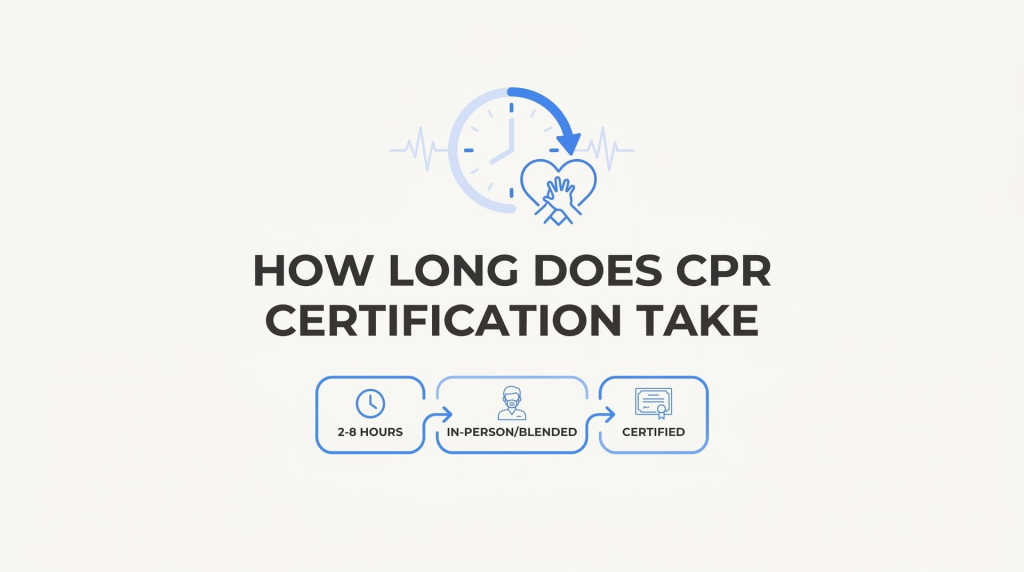
If you want the short version: most standard CPR certification courses take somewhere between 2 and 5 hours to complete. That’s roughly the length of a movie or a long lunch break, depending on the course. For the majority of people seeking a basic certification, this is entirely achievable in a single day.
But that range exists for a reason. Several variables influence exactly how long you’ll spend in training.
Certification Level: A CPR-only course is shorter than a combined CPR, AED, and First Aid course. The more skills the course covers, the more time you need to learn and practice them. This is the single biggest factor affecting course length.
Delivery Format: Whether your course is fully in-person, blended with an online component, or completed entirely online will shape how your time is structured. Some formats let you spread the learning across multiple days; others get you certified in one focused session.
Initial vs. Renewal: If you’re getting certified for the first time, expect to spend more time than someone coming back for a renewal. Renewal courses are designed to refresh and update, not to teach from scratch.
To give you a clearer picture, here are the main certification types you’ll encounter and their general time ranges. Heartsaver CPR/AED, designed for the general public and workplace responders, typically runs 2 to 3 hours. A Heartsaver CPR/AED with First Aid combo stretches to roughly 4 to 5 hours. Basic Life Support, or BLS, for healthcare providers generally takes 3 to 4.5 hours. Advanced certifications like ACLS (Advanced Cardiovascular Life Support) and PALS (Pediatric Advanced Life Support) are a different category entirely, often requiring 12 to 16 hours spread across one or two days.
Each of these serves a different audience and a different purpose. When considering choosing the right lifesaving certification, the sections below break them down in more detail so you can identify exactly which one applies to you.
Time Breakdown by Certification Level
Not all CPR courses are built the same, and the level of certification you need will largely determine how much time you’re committing. Here’s what to expect across the main course types.
CPR/AED and CPR/AED/First Aid Courses
For most individuals, small business owners, and general workplace responders, a Heartsaver-style course is the right fit. A CPR and AED-only course typically runs about 2 to 3 hours. You’ll learn adult, child, and infant CPR, how to use an automated external defibrillator, and how to respond to choking. It’s focused and efficient.
If you add First Aid to the mix, you’re looking at roughly 4 to 5 hours. This expanded course covers wound care, burns, fractures, allergic reactions, and other common emergencies alongside the CPR and AED content. For small business owners trying to meet workplace CPR requirements, this combination course is often the most practical single investment.
There’s also a non-certification option sometimes called a Friends and Family course or Heartsaver Essentials. These awareness-level programs can be completed in as little as 1 to 2 hours. They’re great for parents or community members who want basic knowledge, but they typically don’t result in a certification card, so they won’t satisfy employer or regulatory requirements.
BLS for Healthcare Providers
Basic Life Support is the standard certification for nurses, medical assistants, paramedics, dental hygienists, and other healthcare professionals. Because the course goes deeper into clinical application, including two-rescuer CPR, bag-mask ventilation, and more rigorous skills testing, BLS generally takes 3 to 4.5 hours to complete.
The skills verification component is more thorough than in a Heartsaver course, which accounts for the additional time. If you’re a healthcare provider, this is the certification your employer almost certainly requires, and many careers require CPR certification at this level or above.
Advanced Certifications: ACLS and PALS
ACLS and PALS are in a different category altogether. These courses are designed for physicians, advanced practice nurses, and other clinicians who manage cardiac arrest and complex emergencies in hospital settings. The content covers pharmacology, cardiac rhythms, systematic case management, and team dynamics in resuscitation scenarios.
Plan for 12 to 16 hours of training, typically spread across one or two full days. Understanding the ACLS certification cost and time investment upfront helps you plan accordingly. If you’re pursuing these certifications, your employer or clinical program will usually provide scheduling guidance.
How Course Format Changes Your Time Commitment
Beyond the certification level, the format you choose can meaningfully change how your training time is structured. You have three main options, and each comes with its own rhythm.
In-Person, Hands-On Classes
The traditional in-person format is exactly what it sounds like: you show up, you learn, you practice on manikins, and you leave with your certification card the same day. All instruction, demonstration, and skills testing happen in a single session. There’s no prep work required beyond showing up ready to participate.
This format is ideal if you want to get it done in one shot. It’s also the most effective for skill retention, since you’re getting real-time feedback from an instructor while practicing compressions and rescue breaths. Building hands-on CPR confidence through in-person classes means you can walk in and walk out certified without any waiting period.
Blended and Hybrid Courses
Blended learning has become increasingly popular, and for good reason. These courses split the training into two parts: an online portion you complete at your own pace, typically lasting 1 to 2 hours, followed by a shorter in-person skills session that focuses entirely on hands-on practice and testing.
The appeal is flexibility. You can knock out the knowledge portion during a lunch break or after the kids go to bed, then come in for a condensed skills session that may only run 60 to 90 minutes. A blended learning CPR approach keeps the total time invested similar to a full in-person course, but the structure fits more naturally into a busy schedule.
Fully Online Courses
Fully online CPR courses exist, and they can be completed in a couple of hours from your couch. However, there’s an important caveat worth understanding before you go this route.
Many employers, healthcare facilities, and regulatory bodies require a hands-on skills component for a certification to be considered valid. An online-only certificate may not satisfy your employer’s compliance requirements or meet the standards set by certifying organizations for certain roles. Before choosing a fully online course, verify with your employer or licensing board that it will be accepted. For most professional and workplace purposes, a course with a live skills component is the safer choice.
Renewal vs. First-Time Certification: What to Expect
Once you’re certified, the clock starts. CPR certifications are generally valid for two years, which means renewal becomes a recurring part of your safety routine. The good news is that renewal courses are designed to be shorter and more efficient than the original certification.
Renewal courses typically run about an hour shorter than the initial course. Rather than teaching the material from the ground up, they focus on reviewing current guidelines, refreshing your technique, and verifying that your skills are still sharp. Understanding how to complete your CPR renewal class ahead of time makes the process even smoother.
This efficiency is by design, but it doesn’t mean renewals are less important. The American Heart Association updates its CPR and emergency cardiovascular care guidelines on a periodic basis, with the most recent updates coming in 2025. Renewal courses incorporate those changes, so staying current means you’re always practicing the most evidence-based techniques rather than outdated methods.
For workplaces, lapsed certifications can also create real compliance gaps. Industries like healthcare, childcare, construction, and fitness often have specific requirements around maintaining active certifications for employees. Learning more about CPR certification expiration and renewal can help you avoid those gaps before they become a problem.
The simplest approach is to treat your two-year renewal as a scheduled calendar event, not something to scramble for when your card expires. Many providers, including Respond and Rescue, offer group renewal sessions that let entire teams recertify together, which saves time and keeps everyone on the same schedule.
Tips to Make the Most of Your Training Time
Knowing how long CPR certification takes is one thing. Getting the most out of that time is another. A few practical steps can make your training session run smoothly and ensure you leave feeling genuinely prepared, not just technically certified.
Match the course to your actual needs: A small business owner whose goal is workplace compliance has different requirements than a labor and delivery nurse or a first-time parent. Choosing the right certification level from the start means you’re not sitting through content that doesn’t apply to you, and you’re not leaving with gaps in the knowledge you actually need.
Look for same-day certification options: If your schedule is tight, prioritize providers that offer immediate CPR certification through in-person or blended formats. Respond and Rescue specializes in exactly this: you show up, you train hands-on, and you leave certified. No waiting for a card in the mail, no multi-week course commitment.
Use blended formats strategically: If you know your day-of availability is limited, a blended course lets you front-load the knowledge portion at home. Completing the online modules before your skills session means the in-person time is focused entirely on practice, which is where the real learning happens anyway.
Come prepared to participate: Wear comfortable clothing you can move in, since you’ll be kneeling on the floor and performing compressions. Review any pre-course materials your provider sends in advance. Arrive a few minutes early so you’re not rushing when the session starts. These small things keep the class on schedule and help you absorb more during the hands-on portion.
Ask questions during the skills practice: Your instructor is there to correct your technique in real time. That feedback is one of the biggest advantages of in-person training over any online alternative. Use it.
Finding the Right CPR Course for Your Schedule
Now that you understand the time variables, the question becomes: which course actually fits your life? The answer depends on who you are and what you’re trying to accomplish.
For Individuals and Families
If you’re a parent, caregiver, or community member who wants to be prepared for emergencies at home, a standard CPR, AED, and First Aid certification course covers everything you need in a single afternoon. You’ll walk out knowing how to respond to cardiac arrest, choking, and common injuries in adults, children, and infants. That’s a meaningful skillset to have, and it takes about the same time as watching a couple of episodes of your favorite show.
For Small Business Owners
If you’re running a business, your training needs go beyond personal preparedness. Depending on your industry, you may have OSHA-related expectations or industry-specific requirements around employee safety training. Scheduling a group training session at your workplace is often the most efficient path forward.
On-site CPR training eliminates travel time for your entire team, lets everyone get certified together, and can often be tailored to your specific workplace environment. Respond and Rescue offers on-site group training sessions designed exactly for this scenario. Instead of sending employees to different classes at different times, you bring the instructor to your location and get everyone certified in one organized session. It’s a practical solution that keeps your business compliant and your team prepared without disrupting operations more than necessary.
For Healthcare Professionals and Aspiring Instructors
If you’re a healthcare provider, plan for BLS as your baseline, with ACLS or PALS added depending on your clinical role. Yes, these courses require more time upfront. But the investment reflects the complexity of the scenarios you’ll face professionally, and the certification is a career requirement, not optional continuing education.
For those interested in becoming CPR instructors themselves, Respond and Rescue also offers instructor certification courses. If you’re curious about the path, learn how to become a CPR instructor through a complete step-by-step guide. The time commitment is more substantial, but the long-term value is significant: you’ll be equipped to train others, which multiplies the safety impact well beyond your own certification.
The Bottom Line on CPR Certification Time
CPR certification is one of the most time-efficient safety investments you can make. A few hours of your time can give you the skills to keep someone alive until emergency services arrive. That’s not a small thing.
To recap the key time ranges: CPR and AED-only courses run about 2 to 3 hours. CPR, AED, and First Aid combo courses take roughly 4 to 5 hours. BLS for healthcare providers is generally 3 to 4.5 hours. Advanced certifications like ACLS and PALS require 12 to 16 hours across one or two days. Renewal courses are typically an hour shorter than the original. And blended formats let you split the commitment across your own schedule.
Whatever your situation, there’s a course format and certification level that fits your timeline. The only step left is choosing it and showing up.
When a real emergency hits, there’s no pause button and no second chances. Get hands-on CPR, First Aid, and AED training that prepares you to act fast and with confidence when it matters most. Find a local class or schedule your on-site training now and leave certified, prepared, and ready to save a life.


