 Skip to content
Updated for 2026 — You’re scrolling through your phone during lunch, trying to find a CPR class that fits into your already packed schedule. The traditional eight-hour Saturday course? That’s the day you promised to finally clean out the garage. The weeknight class? That’s when your kids have soccer practice. You know CPR certification is important — maybe even required for your job — but finding a full day to sit in a classroom feels impossible right now.
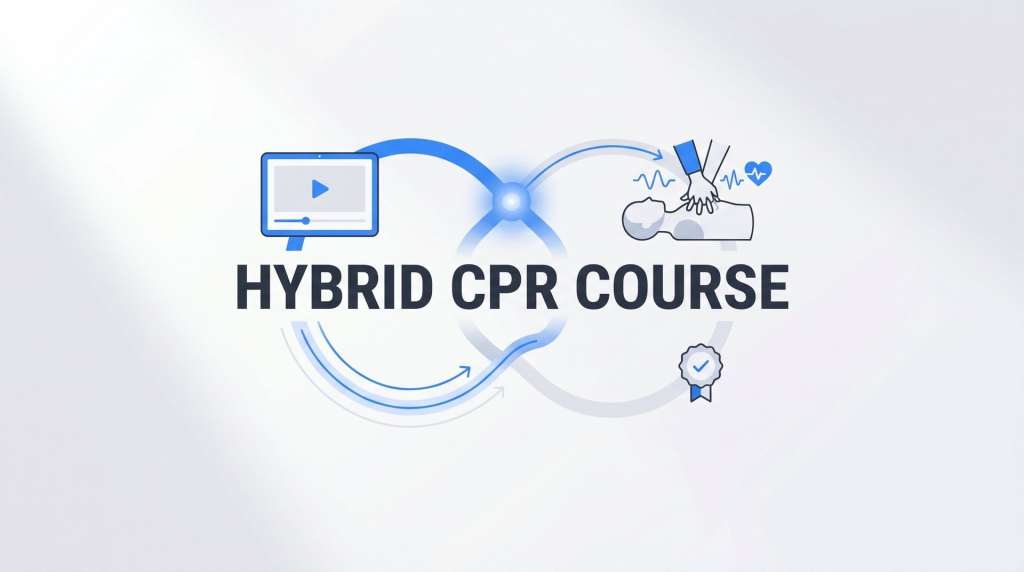
This is exactly why hybrid CPR courses have surged in popularity in 2026. They split the training into two manageable pieces: you complete the theory online whenever you have time, then show up for just a few hours of hands-on practice. You get the same certification, the same lifesaving skills, and the same confidence to act in an emergency. The only difference? You’re not sacrificing an entire day or rearranging your life to make it happen.
In this guide, we’ll walk through exactly how hybrid CPR courses work, who benefits most from this format, and what you need to know before enrolling. Whether you’re a healthcare worker needing recertification, a small business owner meeting compliance requirements, or simply someone who wants to be prepared for emergencies, understanding the hybrid approach will help you make the smartest choice for your situation.
The Two-Phase Learning System That Makes Hybrid Work
A hybrid CPR course breaks training into two distinct phases that work together seamlessly. The first phase happens entirely online, on your schedule, in your space. You’ll work through modules that cover the cognitive foundations of CPR: recognizing the signs of cardiac arrest, understanding the chain of survival, learning when and how to use an AED, and grasping the theory behind chest compressions and rescue breaths.
This online portion typically takes between one and two hours to complete. You can knock it out in one sitting during a quiet evening, or break it into smaller chunks during your commute or lunch breaks. The content includes videos, interactive scenarios, and knowledge checks that ensure you’re absorbing the material. Think of it as building your mental framework, the “why” and “when” of CPR, before you practice the “how.”
Once you complete the online modules and pass the cognitive assessment, you move to phase two: the in-person skills session. This is where theory transforms into muscle memory. You’ll spend approximately two to three hours in a classroom with an instructor and other students, practicing on manikins. This isn’t a lecture. You’re on the floor, performing chest compressions, delivering rescue breaths, and operating a training AED under direct supervision.
The instructor watches your technique, provides immediate feedback, and ensures you meet the physical performance standards required for certification. Can you compress at the right depth and rate? Are you creating an effective seal for rescue breaths? Can you confidently operate an AED from start to finish? These are skills that simply cannot be verified through a computer screen, which is why this hands-on CPR component remains non-negotiable.
The beauty of this split approach is efficiency. When you arrive for your skills session, everyone has already learned the foundational concepts. The instructor doesn’t need to spend time lecturing about when cardiac arrest happens or why compressions matter. Instead, you dive straight into practice, repetition, and skill refinement. You leave with the same certification card as someone who sat through an eight-hour traditional class, but you’ve done it in a way that respects your time and learning preferences.
The People Who Thrive with Hybrid Training
Hybrid CPR courses weren’t designed for everyone, but for certain groups of people, they’re an absolute game-changer. Busy professionals top that list. If you’re juggling client meetings, project deadlines, and business travel, blocking out an entire Saturday for training feels like a luxury you can’t afford. The hybrid format lets you complete the cognitive work during downtime, maybe on a flight or after the kids go to bed, then schedule your skills session during a lunch break or early morning slot.
Healthcare workers needing recertification find hybrid courses particularly valuable. If you’re a nurse, EMT, or allied health professional, you already know CPR theory inside and out. Sitting through hours of review material you learned years ago feels redundant. The hybrid approach lets you breeze through the online refresher at your own pace, then show up for focused skills practice to prove you’ve maintained your technique. Many healthcare employers actively encourage this format because it minimizes time away from patient care.
Parents with young children face unique scheduling challenges. Finding childcare for an all-day Saturday class can be complicated and expensive. With hybrid training, you can complete the online portion after bedtime or during nap time, then arrange care for just the two to three hour skills session. The reduced time commitment makes the logistics far more manageable, which is one reason parents should know CPR and often choose this format.
Small business owners often choose hybrid courses when they need to certify multiple employees for OSHA compliance or workplace safety requirements. Instead of shutting down operations for a full day while your team attends training, employees can complete the online modules individually on slower days, then attend a group skills session together. This approach minimizes operational disruption while still ensuring your workplace meets safety standards.
The format also works well for self-directed learners who prefer to absorb information at their own pace. Some people need to pause and replay video demonstrations. Others want to review written materials multiple times before moving forward. The online component of hybrid training accommodates different learning speeds without holding back faster learners or rushing those who need more time to process information.
Inside Each Phase of Your Training Journey
Let’s break down exactly what happens during both phases of a hybrid CPR course, starting with the online portion. When you enroll, you’ll receive access to a learning platform loaded with video demonstrations, written content, and interactive scenarios. The modules typically cover recognition of cardiac emergencies, including the difference between cardiac arrest and a heart attack, which is a common source of confusion.
You’ll learn the critical steps of the chain of survival: early recognition and activation of emergency response, early CPR with emphasis on chest compressions, rapid defibrillation with an AED, effective advanced life support, and integrated post-cardiac arrest care. Understanding this chain helps you see how your actions as a bystander fit into the larger emergency response system.
The online training walks you through CPR theory in detail. You’ll learn why chest compressions work, the proper compression depth and rate, the importance of allowing full chest recoil between compressions, and when rescue breaths should be added to compression-only CPR. For AED operation, you’ll watch demonstrations of how these devices work, what the voice prompts mean, and why they’re safe for untrained bystanders to use.
Most platforms include scenario-based learning where you make decisions in simulated emergencies. You might watch a video of someone collapsing and choose the correct sequence of actions: check for responsiveness, call for help, begin CPR, retrieve an AED. These scenarios help cement the decision-making process before you ever touch a manikin. This approach represents some of the best CPR training methodology available today.
At the end of the online portion, you’ll complete a cognitive assessment. This typically consists of multiple-choice questions covering the material you’ve just learned. The passing threshold varies by certifying organization but generally requires demonstrating solid understanding of when to perform CPR, how to recognize emergencies, and the proper sequence of actions. You can usually retake the assessment if needed, and many platforms let you review missed questions to reinforce learning.
Now let’s talk about the in-person skills session, where knowledge becomes capability. You’ll arrive at a training center with your online completion certificate in hand. The instructor will have manikins set up, along with training AEDs and other equipment. After a brief welcome and overview, you’ll get straight to hands-on practice.
Chest compressions come first for most courses. You’ll position yourself beside the manikin, place your hands correctly on the center of the chest, and begin compressions. The instructor watches your body position, checks that you’re compressing to adequate depth (at least two inches for adults), and ensures you’re maintaining the correct rate (100 to 120 compressions per minute). This is harder than it looks, and you’ll likely work up a sweat. That’s normal and expected.
Next comes rescue breaths. You’ll learn to properly open the airway using the head-tilt, chin-lift method, create an effective seal over the manikin’s mouth, and deliver breaths that make the chest visibly rise. The instructor checks your technique and helps you troubleshoot if air isn’t going in properly. You’ll practice the full CPR cycle: 30 compressions followed by two breaths, repeated continuously.
AED practice involves turning on the training device, following the voice prompts, applying the pads correctly to the manikin’s bare chest, ensuring everyone is clear before the shock, and resuming CPR immediately after shock delivery. You’ll run through complete scenarios that combine all these skills: finding an unresponsive person, calling for help, performing CPR, using the AED, and continuing care until help arrives.
The skills assessment happens throughout the session. The instructor observes your performance and provides a pass/fail evaluation based on whether you meet the required competencies. This isn’t a written test. It’s a practical demonstration that you can physically perform the skills correctly and confidently. Most students pass on their first attempt, especially since the instructor has been coaching you throughout the practice session.
Comparing Your Training Options Side by Side
When you’re deciding between hybrid and traditional in-person CPR training, the most obvious difference is time commitment. A traditional course typically runs four to eight hours, depending on the specific curriculum and whether you’re learning CPR alone or combined with first aid. You’re in a classroom the entire time, moving through lectures, demonstrations, practice, and assessment in one continuous session.
Hybrid courses split that time differently. You might spend 90 minutes on the online portion and two to three hours in the skills session, totaling around four to five hours of learning. But here’s the key difference: those hours are distributed across your schedule instead of demanding a single block of time. For many people, finding scattered pockets of time is far easier than clearing an entire day.
Scheduling flexibility represents another major distinction. Traditional classes run on fixed schedules. If the only available session is Tuesday at 6 PM and you have a standing commitment then, you’re out of luck until the next session opens up. Hybrid courses offer more options because the online portion happens whenever you want, and skills sessions often run more frequently since they’re shorter. Some providers offer skills sessions multiple times per week, early mornings, evenings, even weekends.
Despite these format differences, the certification you receive is identical. Both the American Heart Association and American Red Cross issue the same certification cards whether you complete a hybrid course or a traditional in-person class. The card doesn’t indicate which format you used. Employers, licensing boards, and regulatory agencies recognize both equally. If your workplace requires CPR certification for compliance, the hybrid format satisfies that requirement just as fully as traditional training.
The learning experience itself differs in subtle but meaningful ways. In traditional classes, everyone learns at the same pace. The instructor presents material, and the group moves forward together. This works well for some learners but can feel slow for those who grasp concepts quickly or rushed for those who need more processing time. This blended learning CPR approach lets you control the pace of cognitive learning while still providing group-based skills practice.
That said, traditional in-person classes do offer some advantages that might matter depending on your situation. If you’re a hands-on learner who struggles with online content, spending the full day with an instructor providing live demonstrations and immediate answers to questions might feel more comfortable. Some people also prefer the structure of a scheduled class that forces them to show up and complete the training in one shot, rather than needing self-discipline to finish the online portion.
For workplace group training, traditional classes can make more sense logistically. If you’re certifying ten employees at once, bringing an instructor to your location for a full-day session might be simpler than coordinating everyone’s online completion and scheduling a group skills session. The right choice depends on your team’s size, schedule flexibility, and learning preferences.
Finding Quality Training That Meets Your Needs
Not all hybrid CPR courses deliver the same quality of training, so choosing the right provider matters. Start by verifying that the course is certified by a nationally recognized organization. The American Heart Association and American Red Cross are the two primary certifying bodies in the United States. Courses certified by these organizations meet established standards for curriculum content, instructor qualifications, and skills assessment rigor.
When you’re evaluating providers, pay close attention to what’s included in the hands-on skills session. The session should last at least two hours and provide ample opportunity for individual practice and feedback. Be wary of providers offering “quick” skills checks that last 30 minutes. Quality training requires sufficient time for you to practice, make mistakes, receive coaching, and demonstrate competency. If the skills session feels rushed, you’re not getting adequate preparation for real emergencies.
Instructor qualifications make a significant difference in your learning experience. Certified CPR instructors undergo their own training and must maintain current certifications and teaching credentials. When researching providers, look for information about instructor backgrounds. Are they healthcare professionals? Do they have emergency response experience? If you’re curious about the path instructors take, you can learn more about how to become a CPR instructor and what qualifications they need.
The location and setup of the skills session matter more than you might think. You’ll be on the floor practicing compressions, so the training space should be clean, well-lit, and spacious enough for students to work comfortably. Equipment should be well-maintained and sanitized between uses. Professional training centers invest in quality manikins that provide realistic feedback, and they maintain their equipment properly.
Before enrolling, ask specific questions about the course structure. How long is the online portion, and how long do you have to complete it before it expires? What’s included in the skills session? How many students will be in your session? Smaller class sizes generally mean more individual attention and practice time. What happens if you don’t pass the skills assessment on your first attempt? Reputable providers offer opportunities to practice further and retest.
Cost transparency is another quality indicator. The course price should be clearly stated upfront and include both the online access and the in-person skills session. Watch out for providers who advertise a low price for the online portion but then charge separately for the skills session, making the total cost higher than initially apparent. Understanding CPR certification cost upfront helps you budget appropriately and avoid surprises.
Finally, consider the provider’s scheduling flexibility and customer support. Can you easily book and reschedule your skills session if needed? Is there someone you can contact with questions about the online platform or course content? Providers who make the process smooth and supportive demonstrate they value your time and learning success.
Maintaining Your Certification Over Time
CPR certifications don’t last forever, and that’s by design. Skills fade without practice, and guidelines occasionally change as new research emerges. Most CPR certifications remain valid for two years from the date you complete your course. After that period, you’ll need to recertify to maintain your credentials and ensure your knowledge stays current.
Recertification through the hybrid format offers even more convenience than initial certification. If you completed traditional training the first time, you spent hours reviewing material you might have already known. For recertification, the hybrid approach lets you quickly refresh your knowledge online, focusing on any updated guidelines or areas where you need review, then attend a shorter skills session to demonstrate you’ve maintained your technique.
Many providers offer streamlined recertification courses specifically designed for people who already hold current or recently expired certifications. These abbreviated programs assume you have foundational knowledge and focus primarily on skills practice and assessment. Learning how to complete your CPR renewal class can help you navigate this process smoothly. The online portion might take just 30 to 60 minutes, with a skills session lasting around 90 minutes. You’re in and out with your renewed certification in a fraction of the time a full course requires.
Staying current with your certification matters for several reasons beyond just meeting workplace requirements. In the two years between certifications, you’ll likely forget specific details about compression depth, breath delivery, or AED pad placement. Regular recertification ensures these critical details stay fresh. Guidelines do occasionally change based on new research, and recertification courses incorporate these updates so you’re always trained on current best practices.
Some professionals choose to recertify before their current certification expires, especially if they work in healthcare or other fields where lapses in certification can affect employment or licensing. Many careers require CPR certification as a condition of employment. The hybrid format makes it easy to stay ahead of expiration dates without major schedule disruption. You can complete the online portion weeks before your certification expires, then schedule your skills session at a convenient time.
After completing your hybrid CPR course, whether initial certification or recertification, you’ll receive a certification card typically within a few days to two weeks. Digital certificates are often available immediately, which can be helpful if you need proof of certification for employment purposes right away. Keep your certification card accessible, either in your wallet or as a digital file on your phone. You never know when you might need to provide proof of your training.
Beyond maintaining your official certification, consider practicing your skills periodically even between recertification cycles. Mental rehearsal helps: visualize responding to an emergency, run through the steps in your mind, and remind yourself of the key points. Some people find it helpful to watch refresher videos or review their course materials once or twice a year. The more you reinforce these skills mentally, the more likely you’ll be able to execute them confidently if you ever face a real emergency.
Your Path Forward with Confidence and Flexibility
Hybrid CPR courses deliver exactly what they promise: the same lifesaving skills and valid certification as traditional training, packaged in a format that respects your time and accommodates your schedule. You’re not choosing between convenience and quality. You’re choosing a modern approach to learning that recognizes you have competing demands on your time but still need to be prepared for emergencies.
Whether you’re a healthcare professional staying current with recertification requirements, a small business owner ensuring workplace compliance, or simply someone who wants the confidence to help in a cardiac emergency, the hybrid format removes the scheduling barriers that often delay people from getting trained. The online portion lets you learn foundational concepts when and where it works for you. The hands-on skills session ensures you can actually perform CPR effectively when it matters.
The training you receive in a hybrid course is identical to what you’d learn sitting in a classroom for eight hours. The certification card you earn carries the same weight and recognition. The skills you develop are just as solid. The only difference is that you’ve accomplished all of this without sacrificing an entire day or rearranging your life around a fixed class schedule.
As you move forward with choosing a hybrid CPR course, remember that the provider you select matters as much as the format itself. Look for nationally recognized certification, experienced instructors, adequate practice time during skills sessions, and transparent pricing. Ask questions before enrolling, and don’t settle for training that feels rushed or inadequate. Quality preparation could make the difference between confidence and hesitation when someone’s life is in your hands.
The flexibility of hybrid training also makes it easier to stay current over time. When your certification approaches its two-year expiration, you won’t dread the recertification process because you know you can refresh your knowledge quickly online and schedule a brief skills session that fits into your life. This ease of maintenance means you’re more likely to stay certified continuously rather than letting credentials lapse.
When a real emergency hits, there’s no pause button and no second chances. Get hands-on CPR, First Aid, and AED training that prepares you to act fast and with confidence when it matters most. Find a local class or schedule your on-site training now and leave certified, prepared, and ready to save a life.


