 Skip to content
Teacher CPR certification in Fairfax County is not governed by one rule that covers everyone. What you need depends on your role, your school or program, and your employer, and some of those requirements are written down while others are only assumed. The practical move is to get your requirement confirmed first, then book a course that matches it.
This article explains how to find out what your position requires, which course types suit teachers, how to tell a legitimate provider from a card mill, and how to finish certification in a single day. Rules and policies change, so treat anything here about specific requirements as a prompt to verify, not a substitute for checking with your employer.
Who Needs CPR Certification in Fairfax County Schools
Several different kinds of educators work in the county, and each can fall under a different set of expectations. Public school classroom teachers, athletic coaches, special education staff, school health staff, private school teachers, preschool teachers, and child care providers may all be subject to different rules or policies. Some are set by the school division, some by the state, and some by an individual employer or insurer.
Because of that, no general article can tell you what applies to you. Go to the sources that can:
- Your principal or school HR contact. They know whether your position carries a CPR or first aid expectation and which courses the school accepts.
- Fairfax County Public Schools (FCPS) employee guidance. If you work for the public school system, check the division’s current staff policies and any training requirements tied to your job title or assignment.
- The Virginia Department of Education. This is the place to look for state-level rules affecting school staff, including anything specific to coaching.
- The Virginia Department of Social Services. For licensed child care and preschool settings, licensing standards often address staff training in first aid and CPR. Confirm the current standard for your type of license.
If you own or run a small program, such as a private school, tutoring center, or child care business, your licensing agency and your insurance carrier are also worth a call. Insurers sometimes ask for training that the law does not strictly require.
Why the same county can produce different answers
Imagine a high school PE teacher and a private preschool teacher, both working in Fairfax County. The PE teacher may be asked for adult CPR with AED and first aid through the school division. The preschool teacher may need pediatric-focused content, including infant CPR, to satisfy a licensing standard. Same county, different courses.
That is why the best habit is to ask for the requirement in writing before you book anything. An email from your administrator naming the course type, the issuing organization, and whether a hands-on skills session is required will save you from paying for a card that does not count.
CPR, First Aid, and AED: Which Course a Teacher Actually Needs
The vocabulary matters because course names get used loosely. CPR (cardiopulmonary resuscitation) is the combination of chest compressions and rescue breaths used when someone’s heart or breathing has stopped. An AED (automated external defibrillator) is a portable device that analyzes heart rhythm and delivers a shock if needed, guiding the user with voice prompts. First Aid covers the other things that go wrong in a school day: bleeding, choking, allergic reactions, seizures, and injuries from falls or sports.
BLS (Basic Life Support) is a healthcare-provider level of CPR training, with team-based response and techniques like bag-mask ventilation.
Matching the course to the role
- Classroom teachers and coaches: Adult, Child, and Infant CPR with AED, plus First Aid, is the usual fit.
- School nurses and health staff: BLS is typically the expected level, though your employer will specify.
- Early childhood and elementary educators: Look for pediatric-focused content, since children and infants are most of the people you supervise.
Online-only is not always accepted
A common misconception is that any online CPR card will do. Many employers and licensing bodies require a hands-on skills check with an instructor, because you cannot learn proper compression depth and rate from a video alone. Confirm acceptance before you pay.
Certification versus awareness
A certification card is documentation that you completed a recognized curriculum and demonstrated the skills. A short awareness class or video may teach useful basics but usually does not produce a card your employer can file. Cards from organizations such as the American Heart Association and the American Red Cross are commonly valid for two years, but confirm the period with the issuing organization for your specific course. Certification does not last forever, and a lapsed card can leave you out of compliance.
In-Person, Hybrid, and Group Formats Compared
The skills portion is the constant. What changes is where you do the learning and how much time it takes out of your week.
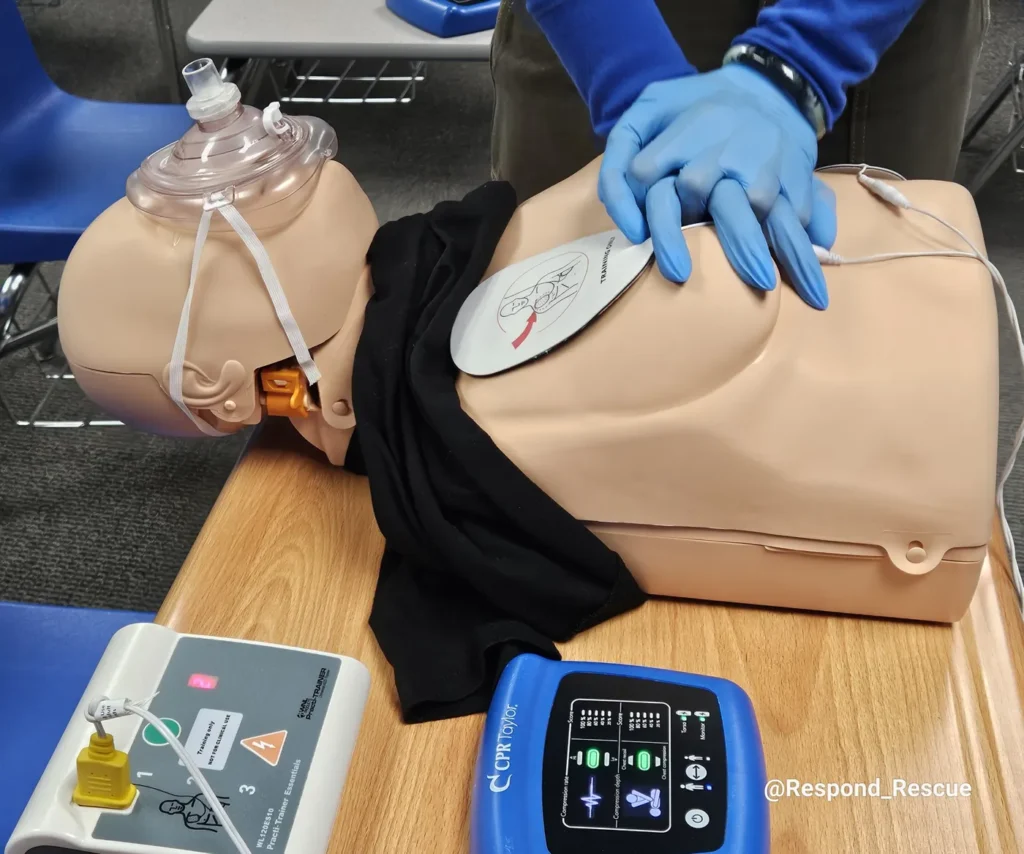
- In-person: All instruction and practice happen with a live instructor in one session. You practice compressions, breaths, and AED pad placement on manikins. Scheduling is fixed, but you finish everything in one visit.
- Hybrid: You complete online coursework on your own time, then attend a shorter in-person skills session. Flexibility is high for the learning portion, and the hands-on part is brief and scheduled.
- Group: A school or department books one session for the whole staff. It often happens at the building, on a professional development day or after hours. Cost per person tends to drop, and everyone finishes at once.
Exact times vary by course and provider, so ask for the current schedule rather than assuming.
Which one suits you
Hybrid works well for teachers with packed days but some room for self-paced study, such as during planning periods or evenings. The online part can be done in small pieces, and you only need to carve out time for the skills session.
In-person is better if you prefer to ask questions as you go, or if you want to be done in one sitting. It also suits anyone who learns best by repetition with an instructor correcting their technique in real time.
Group sessions make the most sense when several colleagues need the same card. One booking replaces a dozen individual ones, and a shared session means the whole team practices together, which is useful if you would ever need to respond to an emergency as a group. Small private schools and child care centers often find this the simplest route to getting every staff member current at the same time.
How to Choose a Legitimate CPR Provider
Not every card carries the same weight. Before you book, run the provider through a short checklist:
- The card comes from a nationally recognized curriculum, such as the American Heart Association or the American Red Cross, or an equivalent your employer has said it accepts.
- The class includes in-person, hands-on practice with an instructor watching your technique.
- The instructors are currently certified to teach the course.
- The provider can state how long the card is valid.
Red flags
- “Instant” cards that require no class time and no practice.
- Online-only courses with no skills test.
- No named curriculum or issuing organization.
- Vague or missing information about how long the card is valid.
Questions to ask before booking
- Will my employer accept this card? (Ask your employer too, and keep the answer in writing.)
- Is the class same-day, from start to card?
- How soon will I receive my card, and is an eCard or a replacement available if I lose it?
Respond and Rescue provides same-day, hands-on certification, so teachers can finish the class and walk out ready to use the skills. Whichever provider you consider, the same questions apply, and a good one will answer them plainly.
What to Expect in a Same-Day Teacher CPR Class
Most classes follow a similar rhythm, even though the details differ by course and provider.
- Check-in. You confirm your registration and course type.
- Short instruction blocks. The instructor explains each skill, often with video, before you practice it.
- Hands-on practice. You work on adult, child, and infant manikins, building muscle memory for compression depth, rate, and breaths.
- AED practice. You apply the pads and follow the device’s prompts.
- Choking relief. You practice the techniques for adults, children, and infants.
- Skills check and assessment. The instructor observes you performing the skills, and you complete a written or online assessment.
Length depends on the course. CPR with AED alone generally takes less time than a course that adds First Aid, and pediatric or BLS options differ again. Confirm the schedule with the provider before you commit your day.
Practical tips
- Wear comfortable clothes, since you will be kneeling and compressing.
- Bring your employer’s written requirement so you can verify the course matches.
- Bring ID if the provider asks for it.
Scenarios worth practicing
Ask your instructor to talk through situations from your own building: a student choking in the cafeteria, a severe allergic reaction in a classroom, a seizure during a lesson, or a staff member collapsing in the hallway. Knowing who calls 911, who retrieves the AED, and who stays with the person turns a class exercise into a plan you can actually use.
After You’re Certified: Renewals, Records, and School Readiness
Certification starts a clock. Note the expiration date on your card the day you receive it, and schedule renewal before it lapses. If your employer requires documentation, send a copy of the card to HR or your administrator right away, and keep your own copy.
It is also worth looking beyond your own training. Ask whether your school has an AED, where it is located, and when it was last checked. A device with dead batteries or expired pads does not help anyone, and staff often do not know where the unit is mounted. Respond and Rescue offers AED sales and management, along with first aid kits for schools and small programs, if your building needs equipment or a maintenance routine.
If you run a small private school, tutoring center, or child care program, think at the staff level rather than the individual level. A group session certifies everyone together, and pairing it with a written emergency preparedness plan covers who does what in a crisis. That combination supports compliance and gives new hires a clear path to get current. As with everything above, check your licensing and insurance requirements as of 2026, since they can change.
Confirm First, Then Get Certified in One Day
The order matters: confirm what your employer or licensing body requires, then choose a hands-on course format that fits your schedule, whether that is in-person, hybrid, or a group session for your whole staff. Getting the requirement in writing first keeps you from paying for the wrong card.
When a real emergency hits, there’s no pause button and no second chances. Get hands-on CPR, First Aid, and AED training that prepares you to act fast and with confidence when it matters most. Find a local class or schedule your on-site training now and leave certified, prepared, and ready to save a life.


